
MGnify Proteins release - 2026_07
spotlight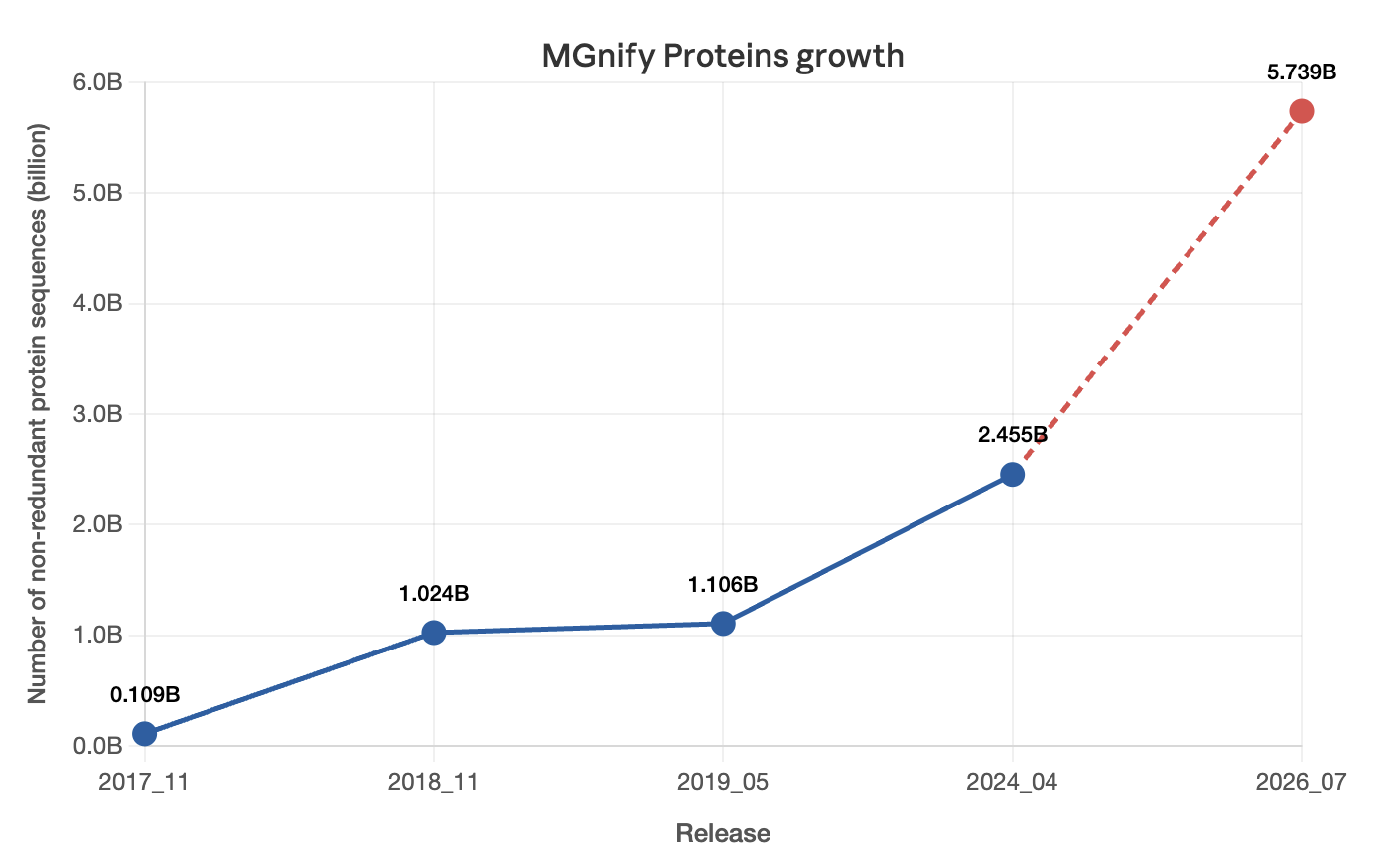 We are happy to announce a new release of the MGnify Proteins database. The last release of the database in April 2024 aggregated over 2.4 billion non-redundant protein sequences generated from publicly available metagenomic datasets. This latest release more than doubles that figure, with over 5.7 billion non-redundant protein sequences now available.
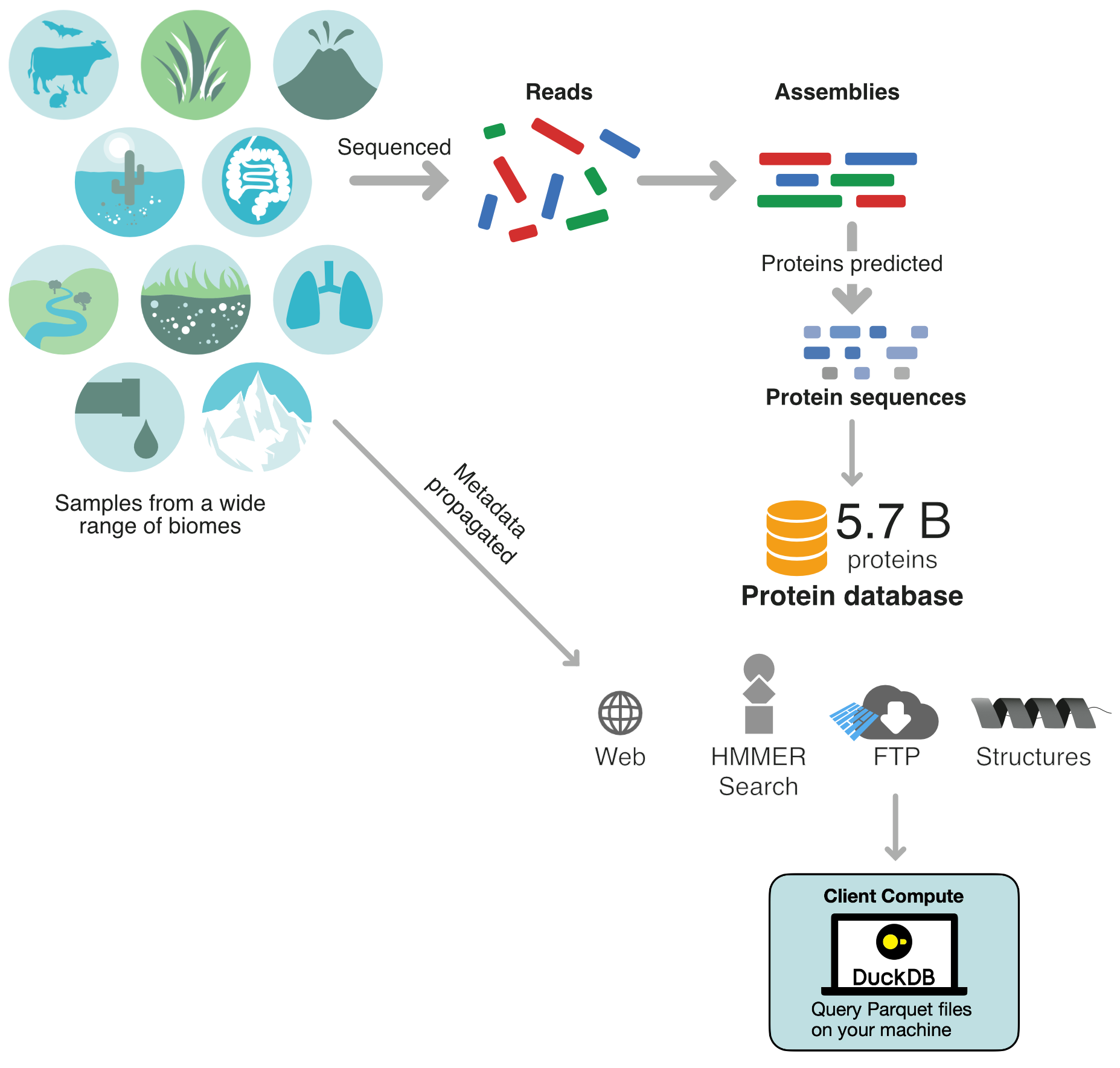
The release also includes over 1.6 billion cluster representatives computed by DIAMOND/Linclust1 at 90% sequence identity (MGnify90). From this set, three further-filtered subsets were generated at 30% sequence identity, which we refer to collectively as “MGnify30”. As with previous releases, all files are available on our FTP server, and this release is supported on the MGnify Proteins Portal. The HMMER web server now also supports searches against the three MGnify30 subsets.
Parquet-based release of MGnify Proteins
A significant update with this release is the generation of all MGnify Proteins data in the Apache Parquet file format, as part of a shift in how we plan to distribute MGnify Proteins files going forward. There are numerous advantages to this shift:
- Columnar data access: As Parquet is a columnar data format, certain query structures that are commonly used to search MGnify Proteins metadata become significantly faster, as only columns of interest need to be searched.
- Native schemas: Parquet stores metadata about each column within a file - including data types - much like a relational database. This explicit structure enables more robust data validation and more efficient queries. For example, querying integer identifiers in a Parquet file is faster than in flat-files without a schema like
.tsv, and Parquet’s structure also supports optimisations such as Bloom filters. - Native compression: Parquet is a compressed file format designed for efficient storage, with data types that help store data more efficiently.
- Partial reading: Partial reading makes it possible to query remote Parquet data without downloading the entire source file.
The ecosystem for working with Parquet is broad, with support in most major programming languages, and with tools like DuckDB. The Parquet files for the MGnify database are available alongside the usual flat files on our FTP server, and can be queried with DuckDB like this:
SELECT *
FROM 'https://ftp.ebi.ac.uk/pub/databases/metagenomics/peptide_database/2026_07/mgy_protein_sequences.parquet'
WHERE protein_id = 46;
| protein_id | full_length | sequence |
|---|---|---|
| 46 | true | MAKEDNIEMQGTVLDTLPNTMFRVELENGHVVTAHISGKMRKNYIRILTGDKVTVELTPYDLSKGRIVFRSR |
Please see the README for information about the schemas of each Parquet file, and our documentation for examples of how to use them. More in-depth release statistics can be found here.
Expanded biome coverage
This release of MGnify Proteins has expanded biome coverage. Human-related datasets have historically dominated the database, but with the latest release we have continued to broaden representation across all biomes, as shown in Figure 2, resulting in significantly more protein occurrences from environmental, engineered, and non-human host-associated biomes than before.
If you have any feedback or questions about the latest release of MGnify Proteins or any other MGnify resource, please get in touch!
-
Buchfink BJ, Barbé É, Ashkenazy H, Reuter K, Kennedy JA, Drost HG, “Clustering the protein universe of life using DIAMOND DeepClust”, Nature Methods 23, 724-727 (2026). doi:10.1038/s41592-026-03030-z ↩