
nf-core/seqsubmit release v1.0.0
spotlight We are pleased to announce the first release of nf-core/seqsubmit, a new Nextflow pipeline that automates the submission of sequencing data — reads, metagenomic assemblies, bined contigs (bins) and metagenome-assembled genomes (MAGs) — to the European Nucleotide Archive (ENA).
Data sharing problem
The scientific community generates a huge amount of nucleotide sequencing data but only a fraction is uploaded to public repositories, which greatly hinders its usability. Researchers must navigate complex database schemas, digest lengthy documentation, manually organise metadata according to strict specifications, and execute multiple interdependent steps. As a result, submission is either delayed or abandoned altogether, depriving the community of potentially valuable resources. nf-core/seqsubmit was started at the nf-core Hackathon 2025/2026 as a community-driven effort to remove that bottleneck.
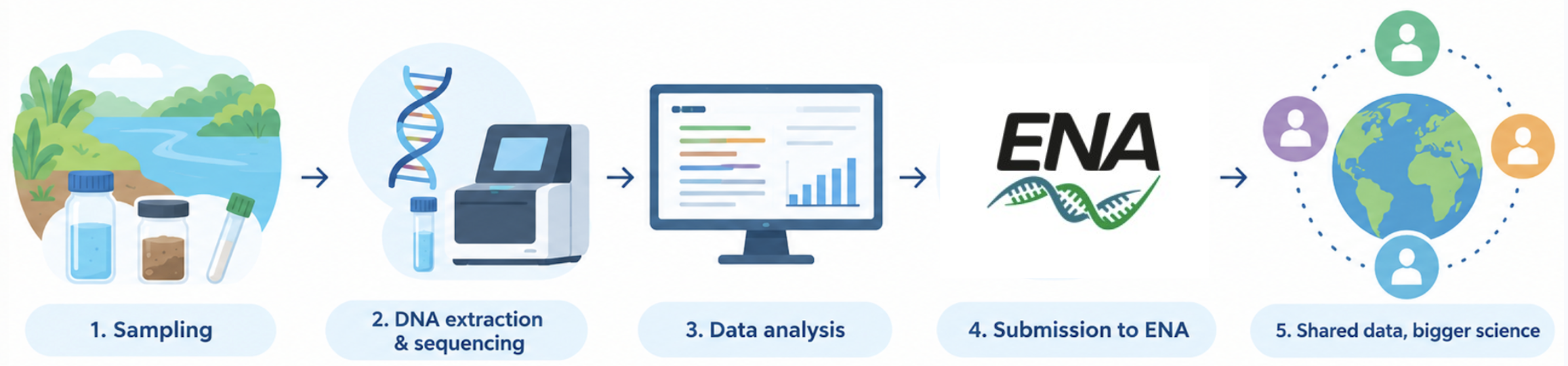
For biological sequence data, the International Nucleotide Sequence Database Collaboration (INSDC) — comprising the EMBL-EBI European Nucleotide Archive (ENA), National Center for Biotechnology Information (NCBI) GenBank, and the DNA Data Bank of Japan (DDBJ) — provides a unified, internationally synchronised archiving system designed specifically for nucleotide sequences. Unlike general-purpose repositories such as Zenodo or Figshare, INSDC databases enforce standardised metadata schemas and structured relationships between biological data entities, and integrate deposited data into global sequence search systems, making it far more suitable for discovery and reuse. That structure comes at a cost, however: submission is considerably more complex than uploading a file, and each provider has different interfaces, tools and requirements.
Automating data preparation for ENA submission
The MGnify team works closely with ENA, retrieving data such as raw sequencing reads and assembled metagenomes, and depositing the products generated by our pipelines, including assembled metagenomes, binned contigs and Metagenome-Assembled Genomes (MAGs). Over years of doing this at scale, we built up a set of Python packages to partially automate the process, and shared them with external collaborators. nf-core/seqsubmit consolidates that expertise into a single, fully automated Nextflow pipeline.
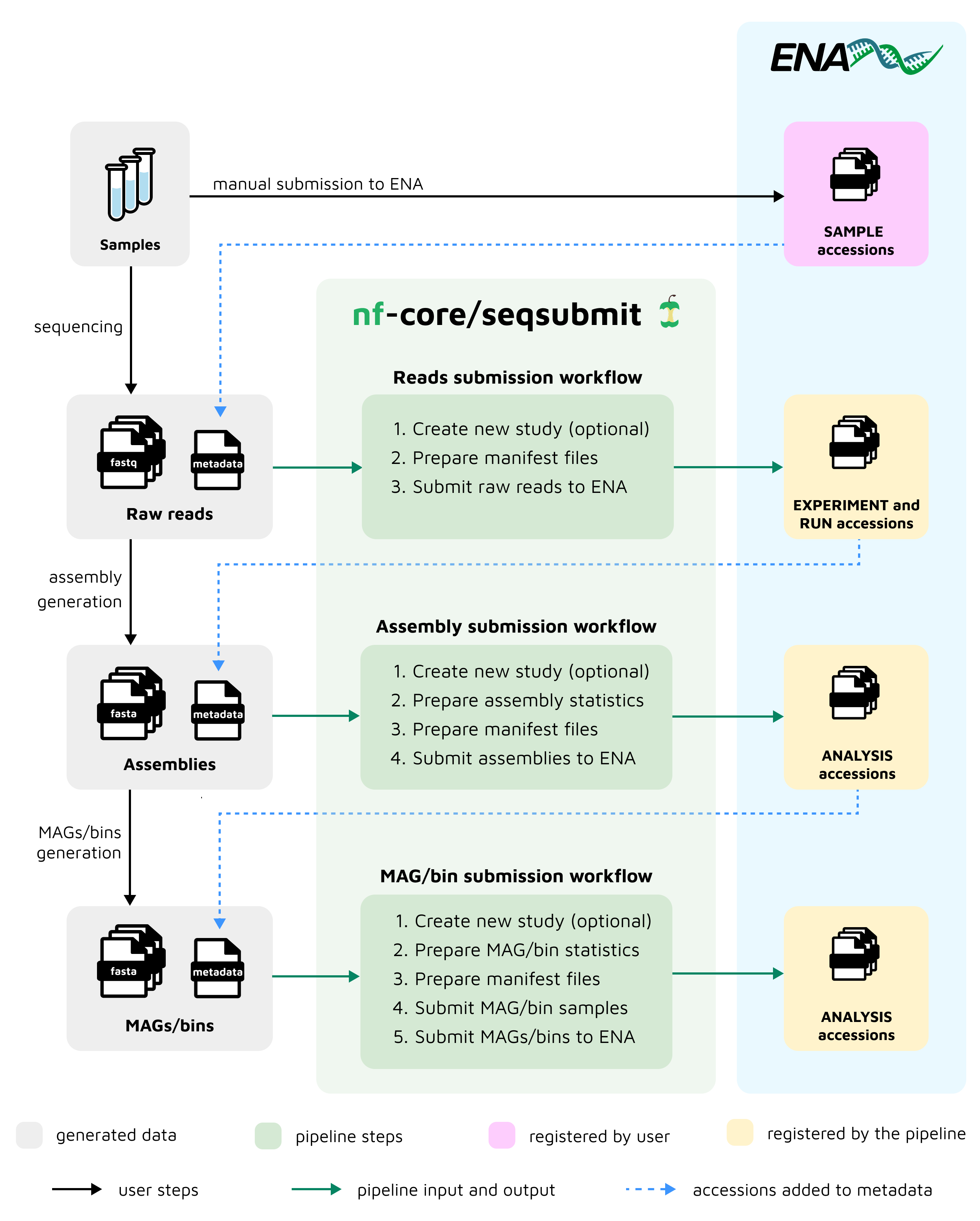 nf-core/seqsubmit accepts four data types, calculates any required statistics, compiles the metadata required by ENA and performs the submission automatically. It organises the submission around the Study associated with the original raw reads, linking derived assemblies and MAGs back to that Study through their Sample records.
All submission is performed programmatically using ENA’s Webin-CLI tool making it a scalable approach suitable for high-throughput workflows.
The pipeline currently supports four modes:
reads— registers raw sequencing reads and their EXPERIMENT/RUN metadata (platform, instrument, library strategy, insert size, etc.), returning ERX/ERR accessions that downstream modes use as their source-RUN reference.metagenomic_assemblies— validates assembly FASTA files (contig IDs and minimum contig count), computes coverage where it isn’t already known, and submits the assembly via assembly_uploader.magsandbins— submit MAGs and bins, gathering additional mandatory metadata such as coverage depth, rRNA and tRNA genes presence/absence, NCBI taxonomy, genome completeness and contamination, and environmental context (provided by user as input metadata), before submitting via genome_uploader.
For each submitted type of data, the pipeline reports the ENA-assigned accession in a summary table.
Results
Beyond its own test suite, nf-core/seqsubmit has already been used in production by a partner project to submit its data to ENA, resulting in 26,621 bins, 4,756 MAGs, and 801 assemblies deposited.
Future work
A major hurdle users still face is registering Studies and Samples with ENA. This process involves selecting and organising the appropriate metadata, linking Samples to their corresponding sequencing-run files, and manually editing manifest files and spreadsheets. As a result, registration remains time-consuming and error-prone. Our team is actively working with ENA to develop utilities that streamline these steps and simplify the registration process.
As the project grows, we hope to attract collaborators familiar with NCBI and DDBJ submission systems, so that nf-core/seqsubmit can expand beyond ENA to support the full INSDC collaboration.